DIVINING ROD: A HISTORY OF WATER WITCHING.
By ARTHUR J. ELLIS.
FORM OF THE DIVINING ROD
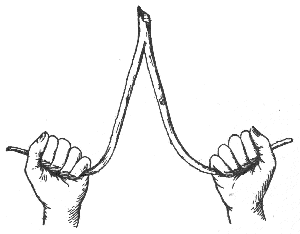 |
| FIGURE 1. - Ordinary divining rod held in the normal manner. |
The opinion as to the kind of wood of which the twig should consist has differed greatly at different times and places, but peach, willow, hazel, and witch hazel are common favorites. By some diviners the twig is cut indiscriminately from any kind of tree, or the device is made of metal or is some common implement, such as buggy whip. Formerly incantations were used in connection with the divining rod.
 |
| FIGURE 2. - Less common manner of holding the divining rod. |
Divining rods have been put to a wide variety of uses since the superstition first became popular, and it is not uncommon even at the present time to find them used by a single person to obtain diverse results, among which there is no conceivable relation. For example, Henri Mager purports to use the rod to detect the presence of water and ores and to measure their depth below the surface, to analyze water and ores, to determine the directions of the cardinal points, to measure the height of trees, and to perform other marvels. (See p. 23.)
 |
| FIGURE 3. - Various old types of divining rods and the ways in which they were held. (After Vallemont, 1693.) |
ORIGIN OF THE DIVINING ROD
The following paragraphs are quoted from Rossiter Raymond's essay on the use of rods for divination:
The Scythians, Persians, and Medes used them. Herodotus says that the Scythians detected perjurers by means of rods. The word rhabdomancy, originated by the Greeks, shows that they practiced this art; and the magic power of the rods of Minerva, Cirace, and Hermes or Mercurv is familiar to classical students. The lituus of the Romans, with which the augurs divined, was apparently an arched rod. Cicero, who had himself been an augur, says, in his treatise on divination, that he does not see how two augurs, meeting in the street, could look each other in the face without laughing. At the end of the first book of this treatise he quotes a couplet from the old Latin poet Ennius, representing a person from whom a diviner had demanded a fee as replying to this demand, "I will pay you out of the treasures which you enable me to find." * * *
Marco Polo reports the use of rods or arrows for divination throughout the Orient, and a later traveler describes it among the Turks. Tacitus says that the ancient Germans used for this purpose branches of fruit trees. One of their tribes, the Frisians, employed rods in church to detect murderers. Finally, if we may trust Gonsalez de Mendoza, the Chinese, who seem to have had everything before anybody else, used pieces of wood for divination.
Thus we perceive that the application of the divining rod in historical antiquity as mainly or wholly moral - that is, it was employed to detect guilt, decide future events, advise courses of action, etc. There are but two passages which have been quoted to prove its use for physical purposes; one from Ctesias (Apud phot. bibl. cod.) who speaks of a rod of the wood Parebus, which attracted gold, silver, other metals, stones, and several other things; the other from Cicero (De Officiis, lib. I), who says, "If we could obtain with the so-called divine rod everything pertaining to food and clothing (ad victum cultumque)," etc.
On the other hand, the silence of many authors is significant, as Chevreul has pointed out. Varro does not mention the use of the rod for the discovery of subterranean waters or metals. Vitruvius, discussing the means of discovering springs, says nothing of it. Pliny, in Book XXX of his Natural History, omits it from his enumeration of magical arts and methods, and in Book XXXI, describing (after Vitruvius) the means of discovering springs, and Book XXXIII, describing explorations for metals, is unusually silent concerning it. Columella, Palladius, and in the sixth century Cassiodorus are likewise dumb, though the latter in one of his epistles (Theodoric, LIII) extols the utility of the professional water discoverers.
There are many great contentions between miners concerning the forked twig, for some say that it is of the greatest use in discovering veins, and others deny it. Some of
those who manipulate and use the twig first cut a fork from a hazel bush with a knife, for this bush they consider more efficacious than any other for revealing veins, especially if the hazel bush grows above a vein. Others use a different kind of twig for each metal, when they are seeking to discover the veins, for they employ hazel twigs for veins of silver; ash twigs for copper; pitch pine for lead and especially tin, and rods made of iron and steel for gold. All alike grasp the forks of the twig with their hands, clenching their fists, it being necessary that the clenched fingers should be held toward the sky in order that the twig should be raised at that end where the two branches meet. Then they wander hither and thither at random through mountainous regions. It is said that the moment they place their feet on a vein the twig immediately turns and twists, and so by its action discloses the vein; when they move their feet again and go away from that spot the twig becomes once more immobile.
The truth is, they assert, the movement of the twig is caused by the power of the veins, and sometimes this is so great that the branches of trees growing near a vein are deflected toward it. On the other hand, those who say that the twig is of no use to good and serious men, also deny that the motion is due to the power of the veins, because the twig will not move for everybody, but only for those who employ incantations and craft. Moreover, they deny the power of a vein to draw to itself the branches of trees, but they say that the warm and dry exhalations cause these contortions. Those who advocate the use of the twig make this reply to these objections: When one of the miners or some other person holds the twig in his hands, and it is not turned by the force of the veins, this is due to some peculiarity of the individual, which hinders and impedes the power of the vein, for since the power of the vein in turning and twisting the twig may be not unlike that of a magnet attracting and drawing iron toward itself, this hidden quality of a man weakens and breaks the force, just the same as garlic weakens and overcomes the strength of a magnet. For a magnet smeared with garlic juice can not attract iron, nor does it attract the latter
when rusty. Further, concerning the handling of the twig, they warn us that we should not press the fingers together too lightly, nor clench them too firmly, for if the twig is held lightly they say that it will fall before the force of the vein can turn it; if, however, it is grasped too firmly the force of the hands resists the force of the veins and counteracts it. Therefore, they consider that five things are necessary to insure that the twig shall serve its purpose: of these the first is the size of the twig, for the force of the vein can not turn too large a stick; secondly, there is the shape of the twig, which must be forked or the vein can not turn it; thirdly, the power of the vein which has the nature to turn it; fourthly, the manipulation of the twig; fifthly, the absence of impeding peculiarities. These advocates of the twig sum up their conclusions as follows: If the rod does not move for everybody, it is due to unskilled manipulation or to the impeding peculiarities of the men which oppose and resist the force of the veins, as we said above, and those who search for veins by means of the twig need not necessarily make incantations, but it is sufficient that they handle it suitably and are devoid of impeding power; therefore, the twig may be of use to good and serious men in discovering veins. With regard to deflection of branches of trees they say nothing and adhere to their opinion.
Since this matter remains in dispute and causes much dissension amongst miners, I consider it ought to be examined on its own merits. The wizards, who also make use
of rings, mirrors, and crystals, seek for veins with a divining rod shaped like a fork; but its shape makes no difference in the matter - it might be straight or of some other form - for it is not the form of the twig that matters [see fig. 3], but the wizard's incantations which it would not become me to repeat, neither do I wish to do so. The ancients, by means of the divining rod, not only procured those things necessary for a livelihood or for luxury, but they were able also to alter the forms of things by it; as when the magicians changed the rods of the Egyptians into serpents, as the writings of the Hebrews relate; and as in Homer, Minerva with a divining rod turned the aged Ulysses suddenly into a youth and then restored him back again to old age; Circe also changed Ulysses' companions into beasts, but afterward gave them back again their human forms; moreover, by his rod, which was called "Caduceus," Mercury gave sleep to watchmen and awoke slumberers. Therefore it seems that the divining
rod passed to the mines from its impure origin with the magicians. Then when good men skrank with horror from incantations and rejected them, the twig was retained by the unsophisticated common miners, and in searching for new veins some traces of these ancient usages remain.
But since truly the twigs of the miners do move, albeit they do not generally use incantations, some say this movement is caused by the power of the veins, others say that it depends on the manipulation, and still others think that the movement is due to both these causes. But, in truth, all those objects which are endowed with the power of attraction do not twist things in circles, but attract them directly to themselves; for instance, the magnet does not turn the iron but draws it directly to itself, and amber rubbed until it is warm does not bend straws about, but simply draws them to itself. If the power of the veins were of a similar nature to that of the magnet and the amber, the twig would not so much twist as move once only, in a semicircle, and be drawn directly to the vein, and unless the strength of the man who holds the twig were to resist and oppose the force of the vein the twig would be brought to the ground; wherefore, since this is not the case, it must necessarily follow that the manipulation is the cause of the twig's twisting motion. It is a conspicuous fact that these cunning manipulators do not use a straight twig but a forked one cut from a hazel bush or from some other wood equally flexible, so that if it be held in the hands, as they are accustomed to hold it, it turns in a circle for any man wherever he stands. Nor is it strange that the twig does not turn when held by the inexperienced, because they either grasp the forks of the twig too tightly or hold them too loosely. Nevertheless, these things give rise to the faith among common miners that veins are discovered by the use of twigs, because whilst using these they do accidentally discover some; but it more often happens that they lose their labour, and although they might discover a vein, they become none the less exhausted in digging useless trenches than do the miners who prospect in an unfortunate locality. Therefore a miner, since we think he ought to be a good and serious man, should not make use of an enchanted twig, because if he is prudent and skilled in the natural signs he understands that a forked stick is of no use to him, for, as I have said before, there are the natural indications of the veins which he can see for himself without the help of twigs. So if Nature or chance should indicate a locality suitable for mining, the miner should dig his trenches there; if no vein appears he must dig numerous trenches until he discovers an outcrop of a vein.
These [divinations] are vain and misleading, and among the first of them are divining rods, which have deceived many miners. If they once point rightly they deceive ten or twenty times.
Possibly they were led to its use from the belief, once universal among educated men like Melanchthon, that metallic ores attracted certain trees which thereupon drooped over the place where those ores were to be found, the drooping no douht being due to the soil or other causes. A branch of the tree was therefore cut and held to see
where it drooped; later on a branch was held in each hand and the extremities tied
together, as shown in an old Italian plate [See fig. 4]; finally, for convenience, a forked branch was cut, the two ends grasped one in each hand with palms upward; the arms of the holder were then brought to the side of the body, so that the forked rod was held in somewhat unstable equilibrium, and the "diviner" set forth on his quest with, in old time, certain solemnities and invocations.
SPREAD OF THE DELUSION.
 FIGURE 4. - Use of divining rods in prospecting for ore. A, Twig; B, trench. (From Agricola, De re metallica, German edition, 1580.) |
The adversaries of the divining rod, on the other hand, like Paracelsus and Agricola, condemned its use as a superstitious and vain practice, without attempting to refute the specific arguments advanced by their opponents or flatly denying its supernatural connections.
A third view was that involving a demoniac influence, and Raymond suggests that the adversaries of the rod, including Agricola, may have adopted their attitude of reserve on the question of Satanic influences from a desire to avoid possible serious consequences. Another view, closely related to that of satanic influence, is described by Raymond as follows:
A fourth view was indeed advanced, according to which the operator, as well as the
rod, was the recipient of a divinely given faculty. It was no doubt with the purpose
of avoiding the odium attached to dealings with the Evil One that the professors of
this science, particularly in Germany, surrounded it with ceremonies and formulas
of a highly pious character. It is true that the rules sometimes prescribed for the cutting of the twig partook largely of heathen sorcery and astrology. They were indeed, to some extent, unconscious reminiscences of the old Scandinavian, and even of the Aryan mythology. But this was atoned for when the rod was duly Christianized by baptism, being laid for this purpose in the bed with a newly baptized child, by whose
Christian name it was afterward addressed. The following formula, cited by Gaetzschmann, may serve as an example: "In the name of the Father and of the Son and of the Holy Ghost, I adjure thee, Augusta Carolina, that thou tell me, so pure and true as Mary the Virgin was, who bore our Lord Jesus Christ, how many fathoms is it from
here to the ore?" In this case, the rod was expected to reply by dipping a certain
number of times, corresponding to the number of fathoms,
In Cornwall the belief was common among the miners and still persists as a tradition, that the divining rod was guided to the ore deposits by the pixies, the fairy custodians of the mineral treasures of the earth.
Not only did the abstract discussion of this subject engage the attention of persons in all classes of society, but nobles and peasants, priests and philosophers - representatives from every class - busied themselves trying to locate ore deposits by means of forked twigs. Probably the most prominent diviners at this time were Baron de Beausoleil (Jean-Jacques de Chatelet), 1576-1643, and his wife. Beausoleil, who was one of the foremost mining authorities of his day, traveled extensively through the mining regions of Europe, visited America in his study of mining, and received important commissions from dukes and emperors, and even from the Pope. His wife shared his responsibilities and honors. But later they fell from favor through the machinations of rivals, and the fact that they used divining rods and other contrivances was made the basis of a charge of sorcery. After some years of persecution they were placed in prison (1642), the baron in the Bastile and his wife in Vincennes, where they died about 1645. Raymond a writes:
In magnifying the art of discovering mines and springs, and the skill required for this purpose, she [the baroness, in "The restitution of Pluto"] gives a description of the means employed, showing that these hidden treasures are to be detected, (1) by
digging, which is the least important way, (2) by the herbs and plants which grow
above streams of water, (3) by the taste of the waters which flow from them, (4) by the vapors which arise from them at sunrise, and (5) by the use of 16 scientific instruments and 7 rods [the 7 rods of Basilius Valentinus] connected with the 7 planets," etc.
The firstst four means were undoubtedly real and really employed. Under the fifth
head we have an illustration of what is so common in the alchemistic and other medieval writers, namely, the covering of the facts of nature and the methods of investigtion with assumed mystery to hide them from the vulgar.
ORIGIN OF "WATER WITCHING."
Teresa in 1568 was offered the site for a convent to which there was only one objection - there was no water supply; happily, a Friar Antonio came up with a twig in his hand, stopped at a certain spot, and appeared to be making the sign of the cross;
but Teresa says, "Really I can not be sure if it were the sign he made, at any rate he made some movement with the twig and then he said, 'Dig just here'; they dug, and
lo! a plentiful fount of water gushed forth, excellent for drinking, copious for washing, and it never ran dry."
This new application of the divining rod no doubt tended to popularize it. It had been of interest chiefly to miners, and outside of mining districts it was probably known only in a vague sort of way. But as a "water finder" it became more generally known, and in the very nature of things its successes must have outnumbered its failures, just as, taking the country over, successful wells outnumber unsuccessful ones.
ECCLESIASTICAL CONTROVERSIES.
About 1671 Matthaeus Willenius published an account of the mercury wand, in which he stoutly defended the use of the divining rod, and two years later Jacques Le Royer announced that the material of which the rod is made is of little consequence, as he claimed to have obtained equally good results with rods made of wood, oxhorn, ivory, gold, or silver.
In 1674 the Jesuit priest Dechales wrote (in "De fontibus naturalibus):
There are two things which astonish me in this experience: Why this rod turns only in the hands of certain persons, and second, why this rod serves equally well locate both underground streams and mines.
USE OF THE DIVINING ROD IN DETECTING CRIMINIALS.
Interest in this case was intense and widespread and called forth a large amount of literature, In commenting on the case Barrett says:
The other one, a hunchback, who was arrested, confessed the crime and was executed: the last person in Europe who suffered that terrible penalty of being "broken at the wheel." * * * Strangely enough the depositions made at the trial showed that Aymar was correct in every detail, witnesses testifying to the flight and halting places of the culprits in the very places Aymar had indicated. * * * Aymar became notorious throughout Europe. He was, however, subsequently somewhat discredited owing to his failure in some tests devised by the Prince de Conde.
This man, Jacques Aymar by name, was sent for - or rather it was not necessary to send for him, since he proved to be already on hand in the city by the time it was
decided to engage his services. This fact is significant as giving the key to what turned out to be an extraordinary piece of clever detective work. A careful analysis
the numerous official and other records of this case shows it to be quite possible that the diviner had obtained important clues before he was publicly set to work. * * * The subsequent tracking of a hunchback would be no very difficult matter. * * * But this achievement of the rod, attested as it was by official records and by the public confession and execution of the criminal made a great sensation in France. * * * Aymar was called to Paris, where both the court and the savants interested themselves greatly in his mysterious powers. Many marvelous feats are reported of him there; but the shrewd and rigorous experiments of the Prince de Conde exposed the emptiness of his pretensions * * *. As late as 1703 this man was employed during the civil war to point out with his divining rod Protestants for massacre, under the plea of punishment for crimes they had committed.
In view of the prevalence of such beliefs as this reign of delusion implies, it is by no means difficult to account for the credence accorded to such claims as those made by Jacques Aymar. Moreover, considering the ordeals of torture inflicted on persons accused of crime to extract confessions, by a strange perversion called "voluntary," and often inflicted on the witnesses as well, and considering also the fact that a public execution was sometimes regarded as a highly diverting spectacle well worth some effort to bring it about, the testimony supporting the claims of Aymar, as repeated to us, combined even with the reported confession of the accused, falls far short of establishing the merit claimed by Aymar, or even the guilt of the hunchback who was executed.
In 1701 the Inquisition issued a decree against the further use of the divining rod in criminal prosecution, and this use of the device rapidly came to an end.
SCIENTIFIC CONTROVERSIES.
LEBRUN AND OTHERS.
THOUVENEL.
Bleton was born at Bouvantes, in Dauphiny, in 1750, or possibly a few years earlier, was brought up by charity in a monastery, and became a herdsman. The first manifestation of "hydroscopic" faculties in Bleton is described in the following paragraph quoted from Barrett, who gives it as a translation from Thouvenel's correspondence dated at Dijon, April 14, 1781:
Bleton when 7 years of age had carried dinner to some workmen; he sat down on a stone, when a fever or faintness seized him; the workmen having brought him to their side, the faintness ceased; but each time he returned to the stone he suffered again. This was told to the Prior of the Chartreuse, who wished to see it for himself. Being thus convinced of the fact, he had the ground under the stone dug up; there they found a spring which, I am told, is still in use to turn a mill.
In the first place, Bleton apparently did not profess to discover immaterial qualities or facts, but chiefly confined himself to the detection of running water. In the second place, he frankly avowed that the rod possessed no power in itself by virtue
of its form or material, and that it was merely an index, outwardly exhibiting to the spectators his inward feeling. This feeling the doctor declared to be a tremor, attacking first the diaphragm and communicating itself through the body and hands to the rod. In the third place this tremor was found by Dr. Thouvenel to be weakened, though not destroyed, when Bleton was on a tree or ladder or other person's shoulder, instead of the ground, or when he touched electrified substances; but the tremor and also the movement of the rod were completely stopped when Bleton was insulated from the ground. Upon facts of this kind he based his electrical theory. I remark, by the way, that the observations and the theory of Mr. Latimer, in his recent work on the divining rod, already mentioned, recall in a striking manner the performances of Bleton and the theory of Thouvenel. Mr. Latimer claims to have made the new discovery that the effect of the divining rod is destroyed by insulating the practitioner, as, for instance, by placing him upon a platform supported by glass bottles. If he had known how thoroughly this claim had been examined and refuted, almost exactly 100 years ago, he would have had less faith in its novelty and value.
Thouvenel's book made no little sensation, and in 1782 Bleton was called to Paris, where a remarkable series of experimental tests were applied to him. A newspaper report of the day declares that in the presence of many thousands of spectators he followed a subterranean aqueduct in the garden of the Luxembourg for 15,000 yards without a mistake. The chief engineer of the waterworks is reported to have said that the trace was so accurate that if the maps of his office had been lost, Bleton's footsteps would have constituted a complete survey to replace them. It is just possible that the Journal de Paris was tempted to make a sensation of this case, and it is also quite possible that a keen observer might notice indications other than those of his own diaphragm, by which he could follow the line of buried pipes. A large number of experiments, more calmly reported, certainly do not sustain the enthusiasm of this account.
It was found, for instance, that Bleton often passed over running water, when blindfolded, without noticing it; and that when taken several times over the same course he would not point out accurately each time the spots which he had previously marked. For example, of 16 points once indicated, he recognized with the rod on the second round but eight, and missed the other eight. A single point to which he was repeatdly brought blindfolded he indicated three times and missed three times. Of seven channels of running water which he was made to cross repeatedly, he indicated one once in four times, another once in four times, and another once in three times, while still another, which he crossed in two spots, affected his diaphragm at one crossing and not at all at the other. The insulation experiment was repeated by a physician at Paris. At a point where Bleton's rod was powerfully affected by alleged subterranean water, he was mounted upon a stool with glass legs, and immediately the rod ceased to be affected. When the stool was removed, however, and he stood upon the ground, the rod resumed its sensitiveness. But Dr. Charles, who conducted this experiment, took occasion, while Bleton stood upon the stool, to bring the top, without his knowledge, into electrical communication with the earth by means of a good conductor, thus destroying the insulation completely, though the hydroscopist supposed it still to exist. Under these circumstances the rod remained inactive, and the destruction of insulation did not produce the slightest result. This was declared at the time to be a proof of Bleton's charlatanry; but, as we shall see hereafter, it is equally consistent with the hypothesis of unconscious mental and muscular action.
Aa a final test of Bleton's capacity as a hydroscopist, he was taken blindfold into the new church of Saint Genevieve, where there was known to be no water for 100 feet below the floor, the vaults, foundations, etc., actually extending all that distance below. Here he professed to discover at numerous points large and small streams of water. Thouvenel subsequently asserted that his protege had been affected by currents of damp air circulating in the cellar, but this explanation was universally considered as a desperate attempt to maintain a theory already brought into discredit by experimental tests. Bleton, however, though he ceased to be seriously respected by impartial scientists, continued to receive much attention, and to do a thriving business, both in Paris and subsequently in the provinces. Here, however, he no longer worked blindfold or professed to see with his diaphragm. He proceeded like the ordinary water diviners, with open eyes, studying all the natural indications, and coming to his decisions with abundant leisure; and under the circumstances it, is beyond doubt that he rendered many valuable services to landed proprietors by successfully locating wells. In many cases, however, he failed entirely, and it is reported that even in those in which he succeeded, he was seldom right as to the depth at which water would be found or the quantity which would be obtained. It should be mentioned that in Dauphiny, where Bleton discovered a large number of springs, he was regarded with an esteem never given to Aymar and some other famous hydroscopists. In other words, the people who knew most about the art of discovering water pronounced Bleton to be a real expert, while they believed Aymar and Parangue to be more or less charlatans. A review of all the facts leave little doubt that in Bleton's case there was an unusually large proportion of the skill of the prospector, combined with rather less than usual of the mysterious claims of the wizard.
CHEVREUL AND FARADAY.
In 1854 Micael Faraday showed that table turning was due to involuntary muscular movements; and in the same year Chevreul, as a member of a committee appointed by the Academy of Science to investigate the divining rod and the magic pendulum, wrote with regard to the divining rod:
It is evident to my eyes that the cause of the movement of the wand does not belong to the physical world, but to the moral world; I think that, in most of the cases in hand, in which the wand is held by an honest man who has faith in it, the movement is the consequence of an act of the mind of that man.
LATIMER.
RAYMOND.
To this, then, the rod of Moses, of Jacob, of Mercury, of Circe, of Valentn, of Beausoleil, of Vallemont, of Aymar, of Bleton, of Pennet, of Campetti - even of Mr. Latimer - has come at last. In itself it is nothing. Its claims to virtues derived from
Deity, from Satan, from affinities and sympathies, from corpuscular effluvia, from electrical currents, from passive perturbatory qualities of organ-electric force are
hopelessly collapsed and discarded. A whole library of learned rubbish about it which remains to us furnishes jargon for charlatans, marvelous tales for fools, and amusement for antiquarians; otherwise it is only fit to constitute part of Mr. Caxton's "History of human error." And the sphere of the divining rod has shrunk with its authority. In one department after another it has been found useless. Even in the one apphcation left to it with any show of reason it is nothing unless held in skillful hands, and whoever has the skill may dispense with the rod. It belongs, with "the magic pendulum" and "planchette," among the toys of children. Or, if it be worthy the attention of scientific students, it is the students of psychology and biology, not of geology and hydroscopy and the science of ore deposits, who can profitably consider it.
BARRETT.
Barrett concluded that the movement of the rod or forked twig is due to unconscious muscular action arising from subconscious and involuntary "suggestion" impressed on the mind of the dowser, and that this subconscious suggestion may be merely an autosuggestion or a suggestion derived through the senses from the environment, but that in a certain number of cases it appears to be due to a subconscious perceptive power commonly called clairvoyance. His conclusions were therefore in a sense favorable to water witching, although completely refuting all claims that there is any physical relation between the underground water and the forked twig or its manipulator, and definitely relegating the subject wholly to the obscure realm of occultism with other varieties of fortune telling.
MAGER.
RECENT INVESTIGATIONS.
MECHANICAL WATER FINDERS.
Most of the present devices are magnetic or electrical instruments, which, taken together, cover almost every application of magnetism and electricity. They range from ordinary dip needles to telepones and devices using wireless waves. Among the most widely advertised instruments of this kind are W. Mansfield's "Patent automatic water and oil finders," Henri Mager's "Indicator of current ground water," and Adolf Schmids's "Device for detecting subterranean waters." Mansfield's instrument was denied a patent in the United States on the ground that it was anticipated by the patent of Adolf Schmids. Mager's instrument, which is described in all his publications (see p. 23), is admitted by him to be only a modification of Schmids's device.
In the letters patent of the Schmids device it is stated that the apparatus will "indicate certain atmospheric changes, the nature and cause of which are not yet understood but which manifest themselves in a peculiar way in the neighborhood of the source and course of subterranean waters by rapid oscillations of the pointer of the device."
The instrument is described as a hollow glass cylinder having an axis around which is spirally wound a soft-iron wire in layers that are separated from one another by paraffined paper, and at intervals by layers of tin foil. The outside layer of the spool is covered with paper. The wire of this spool forms an open circuit. The end of the spool is covered with a glass dial plate having at its center a pivot on which a pointer or needle oscillates.
It is claimed that when the instrument is in the vicinity of a source or a stream of subterranean water the needle will after a time oscillate rapidly.
In the literature advertising its "automatic water and oil finders," circulated by the Mansfield Co., of Liverpool, England, the following claims are made:
The principle on which the instrument works is the indicating of the presence of currents which flow between earth and atmosphere, and which seeking the path of greatest conductivity, are always strongest in the vicinity of subterranean water courses, the waters of which are charged with electricity to a certain degree. In taking observations, wooden pegs are placed at intervals of 20 paces in a direction usually southeast to northwest. The instrument is tried over each of these pegs in turn, and should the needle move on any one of them, tests are made all round it, and the spot where the greatest movement of the needle is obtained is where the boring should be made. If the needle does not move subterranean water does not exist under the spot where the instrument is fixed. * * * The instrument indicates water courses flowing underground in a natural state and not water pipes or sources that have sprung up to daylight.
The magnetic disturbances experienced by the earth are generally of a very complicated nature and reach at times startling magnitudes. Thus during the most remarkable magnetic storm of which there is any record - the one of September 25, 1909 - the compass needle in the vicinity of the city of Washington suffered a change of 5 degrees in the short space of a quarter of an hour and the force acting on it passed through a change during the same period amounting to 10 percent of its full value. * * *
I confidently expect, as soon as a complete analysis has been made of magnetic disturbances covering the greater portion of the earth, it will be found that * * * the disturbances will themselves reveal effects from terrestrial, continental, regional, and even local causes (earth currents, for example, whose path and intensity depend upon local character of soil, etc.).
Since the earth's magnetic state is known to be of a very heterogeneous character, requiring an exceedingly complicated mathematical expression for even a very
approximate representation, it may be confidently expected that any magnetic change
or disturbance, from whatever source it may come and of however simple a type it
may originally be, by the time it has entered the earth's field and has impressed itself on our magnetic instruments, will have been converted into an equally complex type to that of the earth's magnetism itself.