Announcement

Collapse
No announcement yet.

Arduino metal detector?

Collapse
X
 
  • Filter
  • Time
  • Show
Clear All
new posts

  • FoxyLab
    replied
    Originally posted by Vadim18 View Post
    will reduce some current spikes at the signal path.
    But why? During the flow of current through the coil and some time after disconnecting the ADC is not used. Well, then the inrush is simply nowhere to come from.

    Leave a comment:


  • Vadim18
    replied
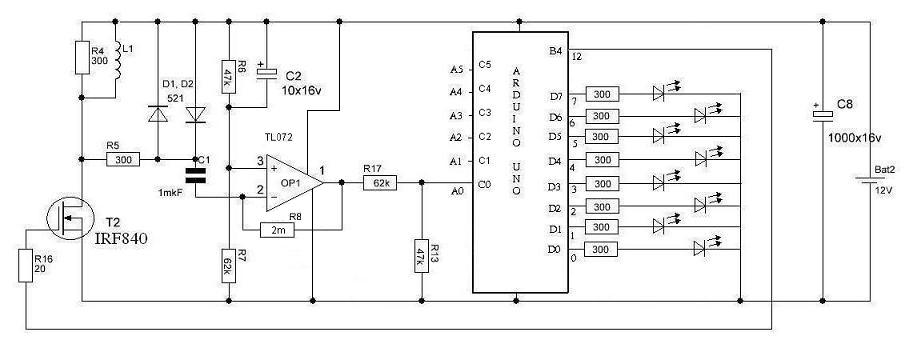
    By the way, did anybody notice what delay insert lm358 in this circuit with slew rate of 0.6 v/us?

    Leave a comment:


  • Vadim18
    replied
    Pirat itself is also quite uniqe project, but I belive this project will be better.
    By the way i discovered one intersting thing today.
    I played with my BeagleBone (raspberrypi-like machine) where i used built in ADC input (with diode clamp protection offcorse), i used shielded wires and was unable to read any adc value until i put ferrite bead between ADC and PI detector. So i fink ferrite bead will help here too, as will reduce some current spikes at the signal path.

    Leave a comment:


  • FoxyLab
    replied
    Originally posted by 6666 View Post
    Just for interest here is a link to simple TL072 project, which runs off a single 12 v supply, a 072 should plug into a lm358, but the results needs to be tested

    http://alex---1967.narod.ru/PI_metal...arduino_u.html
    Yes, "classic" PIRAT schematic.

    Leave a comment:


  • FoxyLab
    replied
    Originally posted by 6666 View Post
    TL071 will run on single supply
    Yes? Then i will simulate this OP in LTspice.

    Leave a comment:


  • 6666
    replied
    Just for interest here is a link to simple TL072 project, which runs off a single 12 v supply, a 072 should plug into a lm358, but the results needs to be tested

    Leave a comment:


  • 6666
    replied
    Originally posted by Vadim18 View Post
    Also we can use unused part of lm358 (or tl072), split amplifier into two stage with gain X28, and add high-pass filter with 100Hz cut off. Otput must be without any capacitors, becouse ADC has some input bias currents.
    And If i not make mistakes, total gain wil be around 770.


    How do you think about my idea?


    ps: i may be wrong)
    [ATTACH]48320[/ATTACH]

    Thanks, interesting idea.

    Leave a comment:


  • 6666
    replied
    Originally posted by FoxyLab View Post
    I built a model of the entire power part of my metal detector for LTspice XVII:
    FoxyPI_v3_tran.asc

    You can play with the parameters and watch, for example, the voltage on the search coil (1), on the ADC input (2), the current in the coil (3):


    Thanks, I got the asc file to work

    Leave a comment:


  • Vadim18
    replied
    Also we can use unused part of lm358 (or tl072), split amplifier into two stage with gain X28, and add high-pass filter with 100Hz cut off. Otput must be without any capacitors, becouse ADC has some input bias currents.
    And If i not make mistakes, total gain wil be around 770.


    How do you think about my idea?


    ps: i may be wrong)
    Click image for larger version

Name:	Two stage amplifier with high-pass filter.png
Views:	1
Size:	9.8 KB
ID:	355600

    Leave a comment:


  • Vadim18
    replied
    Now i understand you)
    I checked tl071 in tinaTI and see no difference except that we need to try a new board layout.
    Click image for larger version

Name:	lm358 tl071.png
Views:	1
Size:	19.6 KB
ID:	355599

    Leave a comment:


  • 6666
    replied
    Originally posted by FoxyLab View Post
    Thanks!!!
    But TL071 is dual supply only? I dont want make negative voltage source, this contradicts the concept of maximum simplicity of the project.
    Its T-34, not Pz.Kpfw. VI ;-) It works even without a PCB.
    You probably haven't seen my VLF /very low frequency/ receiver :-)))
    In addition, the ADC of ATmega328 is also not the height of perfection, so excessive care for one part of the project will be a discord :-)
    Low frequency noise is bad of course, but that is big deal in outdoor finding? On the curves I do not see it.


    TL071 will run on single supply

    Leave a comment:


  • FoxyLab
    replied
    Originally posted by Vadim18 View Post
    Yes, thats why im wondering to! But in opposite shorter bandwidt will produce a less noise) Of course analog part of this detector is less good than digital, so simply placing ne5534 instead of lm358 will boost sensivity. Also high-pass RC filter with R10k and C 0.1 uf beetwen op amp and atmega will be nice, as it help to reduce low frequency noise. I think at nowedays lm358 is one of the best op amp for flicker noise generator project
    Originally posted by Vadim18 View Post
    FoxyLab make a nice project. At least simple and good as reference for comparsion.
    Sory i forget about common mode voltage range limitation, ne5534 will not work here, tl071 will do.
    Thanks!!!
    But TL071 is dual supply only? I dont want make negative voltage source, this contradicts the concept of maximum simplicity of the project.
    Its T-34, not Pz.Kpfw. VI ;-) It works even without a PCB.
    You probably haven't seen my VLF /very low frequency/ receiver :-)))
    In addition, the ADC of ATmega328 is also not the height of perfection, so excessive care for one part of the project will be a discord :-)
    Low frequency noise is bad of course, but that is big deal in outdoor finding? On the curves I do not see it.

    Leave a comment:


  • useus
    replied
    Originally posted by FoxyLab View Post
    Interesting challenge
    I hope you will!

    Maybe with nokia lcd it would be great!

    Leave a comment:


  • FoxyLab
    replied
    Originally posted by useus View Post
    Congratulations for the project, I would be curious to try an adaptation of your software on the felezjoo pi circuit (same avr of your project, similar but different scheme but I think easily adaptable)
    Interesting challenge

    Leave a comment:


  • FoxyLab
    replied
    Thanks!!!

    The FoxyPI firmware version 3.5 is ready - FoxyPIv3_5.ino.eightanaloginputs.hex

    What's new:
    added the ability to adjust the display contrast using the CONTRAST item in the service menu

    An example is small/normal/excessive contrast:

    Leave a comment:
Working...
X