Hi Ivconic.
I think it's great that you ported the Bipolar PI code to AVR. I'm not at all familiar with PICs. I've always worked with AVRs because I find them much simpler. Yesterday, I opened my TDI SL to measure the pulses with the oscilloscope to implement them in the Bipolar PI, and I think I accidentally shorted out the signal and burned the PIC. Honestly, I'm really sorry about what happened. I'm not familiar with PIC programming; in fact, I've never used MPlab, only Arduino. I'll see if I can find a solution; otherwise, I'll have to look for another detector.
-
Yes Eduardo, I always connected the coil wrongly compared to the connection from your schematic!

Leave a comment:
-
I scrolled through the topic and found my post #190.
I watched the video from that post.
Hey! I did a good job and ported the code pretty well!
The only thing that needs to be fixed is the pulse width for the demodulators.
Piece of cake!
Leave a comment:
-
Thanks Eduardo!Originally posted by eduardo1979 View Post
Your video shows 10-20% better air "depths" than my detector.
The diameters of the coils are similar.
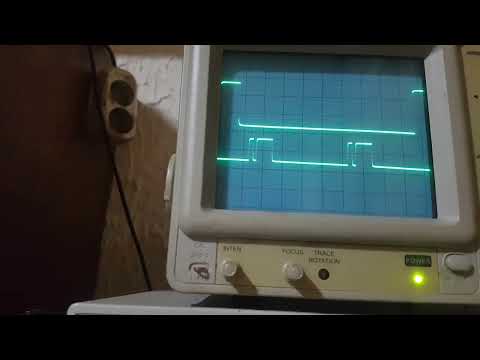
As for damping; I looked at it on the oscilloscope and it looks perfect. Maybe I did something wrong.
It's possible that I didn't connect the coil to the pcb properly.Leave a comment:
-
Hello everyone
And no one showed a diagram of the pulses from the final transistors - why...?Leave a comment:
-
Hi Ivconic.
I've recorded a new video.
Watch it at the link below.
My coil is 11 inches for GPX, and I've installed a 330 Ohm damping resistor. If the damping resistor isn't adequate, the detector won't discriminate. Pay close attention to the TX and RX cable connections and don't reverse them, because discrimination won't work either. Look carefully at the schematic. On mine, I marked them with numbers 1 and 2, and they should match. The frequency is 2 kHz and the delay is 10 uS. Carl's original circuit also discriminates between high- and low-conductivity metals by sound. Watch Carl's video and you'll see. The 74HC4053 isn't the problem, as you describe. The noise you hear in the speaker at low volume is due to the audio driver. I assume it needs to be improved a bit, but that's not the problem with the detector. The cable connecting the coil to the detector must be a stereo audio cable. I haven't protected the coil yet because I'd like to run more tests.Leave a comment:
-
I don't know if the problem is that I used 75HC4053 instead of 74HCT4053?
I don't think it should be any problem.Leave a comment:
-
It's good that you mentioned that.Originally posted by boilcoil View Post
The 390 ohm damping resistor remained on the pcb from before.
With the new 0.32mH coil, I checked how it looks on the oscilloscope; looks perfect!
Just a coincidence, but I think this coil is perfectly "damped" right now.
And admittedly, it can be heard in the sound and behavior.
I didn't pay attention to what the minimum sample delay is. But I think it's good advice.
The question is only with the existing hardware limitations, what minimum sample delay can realistically be expected...
Leave a comment:
-
@ Eduardo;
Can you make a short video and show the detection range in the air on several different coins, preferably smaller diameters.
(please no rings, just coins)
What is the diameter of your coil? What PPS is your video set to? Delay?Leave a comment:
-
Carl, I don't know if I remembered and understood correctly from the book... but as you can see the audio behaves the same on both ferrous and non ferrous metals.
There is no difference in "wee-waa" or "waa-wee" (or however those terms are described).
Maybe I misunderstood in the book, but I expected the audio to behave differently.
I forgot to mention that I put all the original chips back on the sockets, now they are all TL071, 071 and 074. Tried with TLC didn't give any better results.
A couple of things I would like to see improved on this detector:
1) Much greater "depth" on coins (which was to be expected but did not happen)
Big coils and enormous "depths" on targets such as "barrels, tanks, airplanes" do not interest me in the least.
I am exclusively interested in coils with a maximum diameter of ~27cm.
2) Since GEB works fantastically (I really like it) and DISC doesn't exist, it would be nice if the audio made at least some noticeable difference.
I expected better results on coins at 2kHz and with minimal delay.
I said I wouldn't write too many comments, but I suffer from insomnia, so I deny myself.
What I didn't specifically point out is that the application of a quality cable from the coil to the pcb changed the behavior of the detector DRASTICALLY in favor of stability, purity of behavior, purity of sound, etc.
But still in the background of the sound, very quietly, you can hear a "thin" accompanying "buzz" sound. I assume that some part of the clock "breaks through" through the rails to the audio.
I also don't believe that choosing a TL07x type preamp is the best solution. But I have no idea at the moment what to replace them with. And even then, I'm sure the differences would be barely noticeable.
All in all, educational, instructive... it was worth the effort.
And is this a detector that I would go out into nature with?
Not for now.
In addition to Deus 1 and Vanquish 340; it would be redundant to try anything with this detector.
But... if the range was improved to very small coins; I'm SURE that this PI with a GEB like this would be unbeatable in some of my fields.Leave a comment:
-
Hello EduardoOriginally posted by eduardo1979 View Post
It turned out very well - well done.
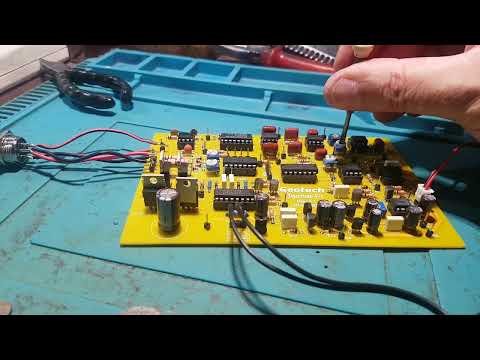
What are these yellow cables for?
They are not here.
Leave a comment:
-
Okay, a few things though...
GEB... even at the minimum ("OFF") it does not detect (does not react to) a piece of ancient brick... to which all VLF/IB detectors I have tried so far react very aggressively, when their GEB is not set (on some, even then, that brick cannot be completely rejected).
So in my case, what I have here; GEB as such is not even needed. Works perfectly even with GEB on "OFF".
BUT!!!
In my case, what I have here, with the targets displayed; For me, GEB behaves like a "DISC" between "colored" targets.
It is impossible to reject iron... but it is very noticeable and easy to see the rejection of certain non-ferrous alloys.
So... "GEB" in this case could be understood as "DISC" which has a certain range of discrimination of some targets and their TC.
Identical to what I saw earlier on the GS4 I was building not so long ago
Maybe I wrote this clumsily, vaguely, sometimes I have problems to write a thought clearly in English. But I'm sure you'll understand.
As for the "hole"... I haven't gotten to that yet.
I wanted to correct previous mess around the coil and the cable and then evaluate the real capabilities of the detector.
I think this detector will be very useful with the smallest coils, say 10-15cm in diameter, at most.
Exactly what I am primarily interested in.
However, I am still not satisfied with the behavior on the smallest targets of the "weak" alloys (an alloy with weak magnetic properties and poor conductivity)...
Leave a comment:
-
Ok, today I found time to do some things.
First, I wound a 0.32mH, 27cm mono coil.
Second, I put a real cable between the coil and the pcb.
I asked a question about this before, I didn't get an answer. So I found the answer myself.
Third... the freq is now fixed at 2kHz.
I won't write further, because I'm tired and very lazy... don't get me wrong, these two videos don't even need special comments, for those who are "in the matter" any additional comments are unnecessary.
For those who are not "in the matter", even 10 pages of comments will not be enough.
Final conclusion: this is a very good starting platform for further development.
But more importantly, for learning. Carl did a very good job.
Leave a comment:


Leave a comment: