

 Tweet
Tweet
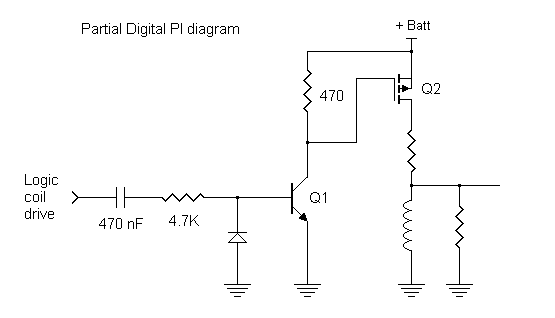
The only thing digital about this is that I do not want anything to burn up if the software leaves the coil drive signal on too long. This could happen if I am debugging the software and hit a breakpoint while the coil is on, or it could happen because of a software error. I have set this up so that the FET will not stay on for longer than a couple of milliseconds.
The logic signal will be low most of the time and Q1 and Q2 will be off. Q2 is P channel. To turn the coil on, the logic signal will go high, which will turn Q1 on, which will turn Q2 on. Normally the logic signal will go low again within a couple hundred micro seconds and the circuit behaves pretty much like a direct coupled coil drive. But if the logic signal gets stuck high for any reason the capacitor will eventually charge up and Q1 will turn off. Hopefully this will prevent Q2 from burning up.
Is there any reason not to use P channel MOSFET's? Everyone else seems to use N channel. I have never designed anything with power MOSFET's before, so I do not know what I am doing. The last time I designed anything like this was at least 20 years ago and I think MOSFET's must have been too expensive then because we were not using them.
Robert
 While debugging my code, I disconnected the coil in order to get rid of that problem. I also started out with a problem where the coil defaulted to "on" at power up and after the code initialized the ports, the coil was turned off. This became a problem if I did something stupid that stopped the code from executing to the point where the ports were set. Like, if I left the LCD unplugged and powered up, it would get very hot. I changed my hardware so that the logic was reversed and a port initialization wasn't required in order to turn off the coil. It was defaulted to off. Its all of those little things you run into while ironing out a design that makes it so fun.
Comment