
This was posted by Brian Deese working on an AF-108 back in 2012:
"I will try it this afternoon,and by they way about the sample.I just wanted to let you guys know,In a previous post I said I would check the "secondary sample also" well there is no secondary sample.This machine feeds one sample from positive pulse and another from the consecutive negative pulse to the differential amp.Thats a change of pace right. And the sample can not start as soon as the other PI machines I have,you cant move the sample up to the egde of the saturation plateau.It can just include a few uS of the linear range of the amp and then the rest of the sample is at zero.I works similarly when you are inching it closer,when you go past a certain point it will not auto tune any longer and no output audio.I set the machine up yesterday for the best performance and its running at 4khz,with a 100uS TX width,and it likes a 40uS sample width the best. And another interesting thing about it since I have it running stable"albeit the preamp output" is when you place the coil on the ground and press the auto tune it oscillates at about 1hz,when you lift the coil it loses some ground influence and it goes quiet,sort of a silent search.Pretty neat I think."
-
The final piece of the puzzle. Here is the bipolar pulse drive and RX preamp PCB layout.
For the rest of the circuit, I'll copy the SMP, just for testing.Leave a comment:
-
My strategy in guesstimating the timing sequence would be to assume a PRF the same as the Whites PI1000, and the first and second sample delays are likewise the same( and the pulse widths). This would give me a starting baseline from which I can experiment to see what is the optimum performance. The 390+390 Ohm Rd tells me that the inductance of the coil isn't far off from a regular Surf or PI1000/2000. Thus the PRF I would assume to be within typical range of hundreds of PPS.Originally posted by waltr View Post
In other words, I'm going to superimpose the timing charcteristics of the PI1000, and see what happens.Leave a comment:
-
The issue with adjusting the timing pots is not knowing what the timing should be since there seems to be no documentation on this.
dbanner will need to make some guesses as to timing then a lot of experimenting to determine best timing.Leave a comment:
-
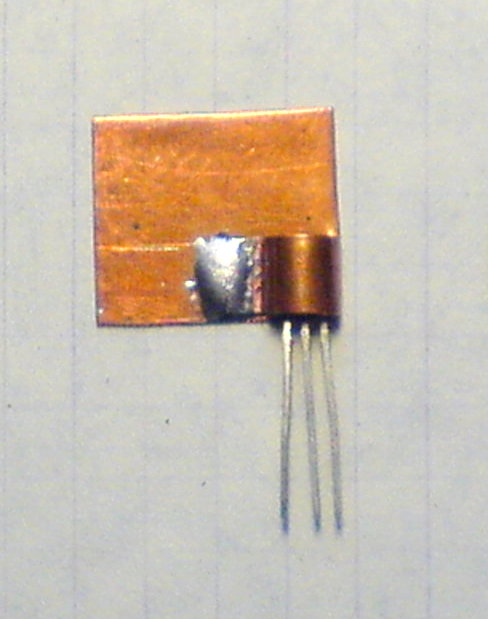
Man can indeed solder the sheet without transistor
Adjust the settings of the trimmer with the oscilloscopeLeave a comment:
-
OH LORD,THAT'S TERRIBLE MURIEL!
Won't the solder melt before the magic smoke appears?
 OK, that will surely work, but not the prettiest sight.
The BUY92 is nothing special(TO-39 package). Easily replaced by something in a TO-126 package. This is least of the worries.
The biggest challenge here is adjusting those trimmers in the pulse generator circuitry.
I have almost completed the remainder of the layout. Will be starting construction soon.
Hope to have a working prototype in about two weeks or so.Leave a comment:
-
-
These heat sinks are easy to turn on the lathe.
But due to lack of availability of the BUY92 this is not necessaryLeave a comment:
-
Great to see a picture of this board and the nice construction.
Those heat sinks were off the shelf back in the day.
No idea if they can still be bought.Leave a comment:
-
Having done some more digging and research, I realized that there was also a PI 150 pipe locator which is a totally different circuit(although it does have similarities).
This was the circuit which was back engineered by Ivconic, and not the AF-108.
I also found a photo of the PCB of the AF-108 mine detector. Note that the quad AND gate is a 4081 just as waltr had speculated(on the schematic it is mislabeled as CD4069). And also have a look at those lovely BUY92's, with there custom heatsinks. Wow! that's fantastic.Leave a comment:
-
There is a AF-108 PI Military Metal Mine Detector listed on ebay, if anyone is interested.
Leave a comment:
-
I hadn't intended to go that far, I feel foolish as it is, any further endeavor with spice and my ego will be crushed. I need to go slow, baby steps.Originally posted by waltr View Post
Besides, I prefer to tinker with the real circuit, at least I'll have a chance to make a working machine instead of a spectacularly complex but useless simulation.Leave a comment:

Leave a comment: