
Originally posted by Mrand
View Post
-
My solution work correctly over 10 year. I maked this for use Whites BlueMax 950 coil. This is sufficiently stable when you use high quality styroflex or SMD C0G capacitor and 10-turn trimmer. The additional advantage is the easy exchange of coils.Leave a comment:
-
Your solution may suffer from slight drift? Which might make detector a bit unstable? Maybe use the nearest value crystal available, and retune your coil to resonate accordingly by adjusting the value of tuning caps? Use 200khz will give 6.25khz. Or use 400khz divide by 64(connect to divide by 64 pin instead).Leave a comment:
-
Here is my solution with 220kHz quartz problem in Wilson detector. Is retuned in range 200-250kHz. It work correctly and exactly. Besides one can connect to Wilson, Whites BM950 coil (6.592kHz).
MrandLeave a comment:
-
The only other low freq crystal/resonator type parts I can think of used in detectors from that time are those used in Fisher machines, 1266, CZ's and similar models. Were they 60 KHz or thereabouts?Leave a comment:
-
Yes,I see. Why has no one used these in designing Tx oscillator to drive Tx coil and for phase shift. I've never seen these before in any metal detector schematic. By the way, I want to build the GC 1023 and have discovered that it is an exact clone of the fisher f2. Now all I need is a schematic since there good pics of the PCB on this forum.Leave a comment:
-
At that frequency, the only main choices are ceramic resonators and tuning-fork crystals. I've used 100 kHz conventional crystals before, and they were huge (HC6U maybe ?) and expensive, not really suitable for detectors. It's probably lack of choice that led to that part.
The other obvious alternative is to use a higher freq crystal( >2MHz ) with more division.
I've just remembered another place I've seen that ceramic package. You used to be able to get a programmable oscillator/divider IC, in a regular DIL package, but with this ceramic boxed crystal visible in the top of it. You used pin selection to get the output frequency you wanted. There were two or three different master crystal freqs available. I can't find any mention of them on the web, and I've no idea if I have any 'spare' parts from the project I used them in, approx 1992.
Edit: Found it: Statek PXO series.

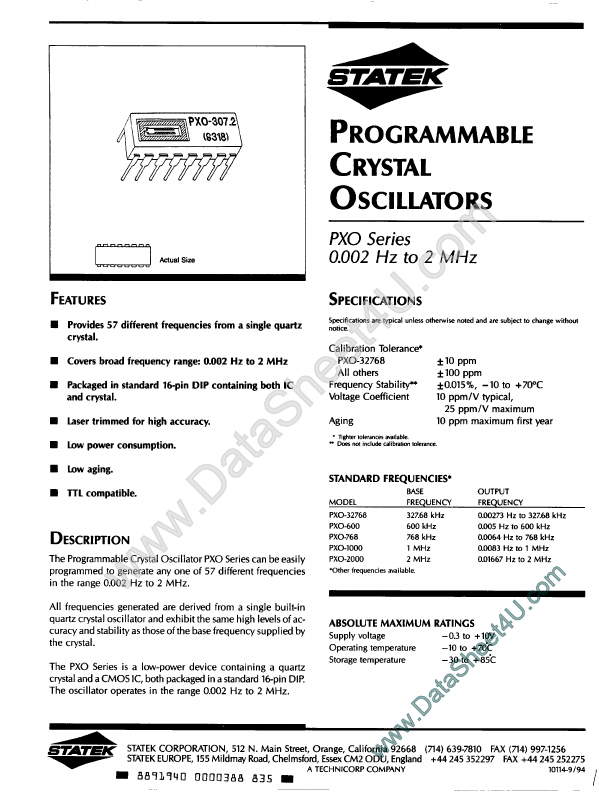
Notice the date codes of these parts, 1984, 1987.Leave a comment:
-
Did Wilson ever work for NASA? That component is atypical and of very high quality especially for its time. Not your garden variety for sure.Leave a comment:
-
I agree, CD4060 is more likely....and if I had paid attention to my 'Parts List.txt' link in my earlier post, it was listed as a 4060 on that.Leave a comment:
-
The chip could be and is most likely the CD4060. The other thing could be a 220Khz glass encased crystal oscillator with internal cap to make it oscillate. Don't see any small pico caps nearby.Leave a comment:
-
Just for technical interest: The operating frequency of this machine (and several other similar Wilson-Neuman machines) is stated as 6.875 KHz. This is 220 KHz divided down by 32.
I also noticed their publicity states "Binary CMOS search-coil", which I guess is advertising baloney hinting at the digital 4000-series logic that drives the coil frequency.
The audio tone is also quoted as 215 Hz, which is 6.875 KHz divided down by 32. My guess is the 'unmarked' chip is a CD4020 oscillator/divider.Leave a comment:
-
Thanks Skippy but your suggest is way over my head! I sent it off to Keith Wills in hopes that he can fix it for me.Leave a comment:

Leave a comment: