Announcement

Collapse
No announcement yet.

Noise question.

Collapse
X
 
  • Filter
  • Time
  • Show
Clear All
new posts

  • Teleno
    replied
    The 15-bit version is much more stable.

    Here's the 15-bit signal after EF and background subtraction.

    The two largest peaks in each graph are the signals of a 0.7g nugget at 7cm (top graph) and at 6 cm (bottom). The rest is the noise.

    One tick of the Y axis represents 2uV at the preamp's input. (Vref / resolution) / Gain = (1.1V / 32768 ) / 17.


    Originally posted by Qiaozhi View Post
    For anyone wanting to understand how oversampling and decimation works, here's a very good explanation (attached).

    Teleno - I haven't looked at your code yet as I'm on holiday this week.
    I dont'want t spoil your vacation . Enjoy!
    Attached Files

    Leave a comment:


  • Qiaozhi
    replied
    For anyone wanting to understand how oversampling and decimation works, here's a very good explanation (attached).

    Teleno - I haven't looked at your code yet as I'm on holiday this week.
    Attached Files

    Leave a comment:


  • Teleno
    replied
    Originally posted by F117 View Post
    My math knowledge is a little bit rusted, so I am just trying to understand what you implemented here - triggered by my simple ring buffer implementation in the Pickini project.
    I assume this initialization is not needed, since it is outside the main loop and targetFilteredValue is already initialized to 0:


    Not sure why you are not using the ring buffer average value ( sum / 64 ) instead of rb.decimated = (sum / 8 )...

    Suppose the ring buffer contains steady values = 64 times 128.
    The next 2 values are 256 instead of 128:

    1. ring buffer [ 64 x 128 ]
    value = 256
    rb.sum = 8320 --> average = 130
    rb.decimal = 1040
    // Assume targetFilterValue is still 0 ( it wouldn't be as there are already 64 samples in the ring buffer...)
    targetFilteredValue = 0 - 0 + 1040
    thisTarget = 1040 / 8 = 130 // The same value as the buffer average

    2. ring buffer [ 63 x 128 and 1 x 256 ]
    value = 256
    rb.sum = 8448 --> average = 131
    rb.decimal = 1056
    targetFilteredValue = 1040 - 16 + 1056 = 2080
    thisTarget = 2080 / 8 = 260 // Almost double the buffer average

    3. ring buffer [62 x 128 and 2x256 ]
    value = 256
    rb average = 134
    thisTarget = 390


    In the Pickini firmware and - if I recall correctly - also in the examples in the book "Inside the metal detector", this very slow running average is used as reference ( ground value).
    So far my 2cts - maybe a more elaborate simulation with values ( in excel ? ) would reveal why there are excessive values ?
    I didn't post the code to make it short but the ring buffer is indeed initialized, the initial targetFilteredValue is not 0 but the sum of 64 samples less three LSBs.

    I didn't use the average because by decimation theory the sum of 64 samples has 3 bits more resolution than a single sample, but the average throws away the extra bits.

    The IIR filter tau is a power of 2 so multiplications and divisions can be faster done by shifting left and right. In this case the tau is 64 samples which produces 90% of the full target value after 2.3 tau periods. At 1kHz it's 2.3 x 64 x 1 ms = 147 ms. At a sweeping speed of 0.5 m/s this 90% of the full signal occurs after 7.4 cm of target exposure.

    I assumed a slow sweeping speed because this PI is intended for detecting nuggets on bedrock, so no large distances are to be covered in a short time. Also, there's a 1KHz higher limit to the TX frequency otherwise the Atmega328P at 16MHz cannot complete acquisition, filtering, sound and display within a Tx period.

    I've also tried a 16 sample ring buffer and a 16 tau IIR filter, each providing an increase of 2.5 bits for a total of 15 bits (10 ADC + 2.5 + 2.5). This allows for faster sweeping with a 90% target response at 2.3 x 16 x 1 ms = 36.8 ms. The sensitivity is halved but it's compensated because for the same sweep speed you can get 99% response after only 8cm of target exposure, less than half the diameter of the coil. Also a threshold of 20 gets rid of the shot or 1/f noise for a sensitivity of 40uV, so in the end the PI performs better.

    Leave a comment:


  • BC547
    replied
    My math knowledge is a little bit rusted, so I am just trying to understand what you implemented here - triggered by my simple ring buffer implementation in the Pickini project.
    I assume this initialization is not needed, since it is outside the main loop and targetFilteredValue is already initialized to 0:
    * Initialize IIR filter. targetRing.decimated is 13 bit */

    targetFilteredValue = targetRing.decimated << 6; // Fixed point arithmetic 26.6
    Not sure why you are not using the ring buffer average value ( sum / 64 ) instead of rb.decimated = (sum / 8 )...

    Suppose the ring buffer contains steady values = 64 times 128.
    The next 2 values are 256 instead of 128:

    1. ring buffer [ 64 x 128 ]
    value = 256
    rb.sum = 8320 --> average = 130
    rb.decimal = 1040
    // Assume targetFilterValue is still 0 ( it wouldn't be as there are already 64 samples in the ring buffer...)
    targetFilteredValue = 0 - 0 + 1040
    thisTarget = 1040 / 8 = 130 // The same value as the buffer average

    2. ring buffer [ 63 x 128 and 1 x 256 ]
    value = 256
    rb.sum = 8448 --> average = 131
    rb.decimal = 1056
    targetFilteredValue = 1040 - 16 + 1056 = 2080
    thisTarget = 2080 / 8 = 260 // Almost double the buffer average

    3. ring buffer [62 x 128 and 2x256 ]
    value = 256
    rb average = 134
    thisTarget = 390


    In the Pickini firmware and - if I recall correctly - also in the examples in the book "Inside the metal detector", this very slow running average is used as reference ( ground value).
    So far my 2cts - maybe a more elaborate simulation with values ( in excel ? ) would reveal why there are excessive values ?

    Leave a comment:


  • Teleno
    replied
    I've read about the noise in ADCs having 3 components: 1/f noise, white quantization noise and phase noise peaking at the sampling frequency. The noise I'm getting looks like 1/f, so I guess I won't be able to get rid of it.

    In any case a noise threshold of 80 uV doesn't look too bad, I can detect a 0.7g gold nugget at 8 - 9 cm at 6.5 us delay, even thoygh I'll probably never find one.

    Leave a comment:


  • Teleno
    replied
    Originally posted by Carl-NC View Post
    If I understand, you have an 8b ADC you are oversampling by 64x. If so, that produces an ideal 11b, not 16b. You get 1/2 bit every time you double the oversampling. So 1.1V/2^11 = 0.54mV LSB.


    Regardless, 4mV sounds a bit high. You would need to post a schematic of the front-end in order to see if this is justified.
    The ADC is 10 bit although at 500KHz only the 8 MSBs are reliable, but I'm using all 10 nevertheless.


    Oversampling at 64 gives me 3 extra bits, but then I pass this to an IIR filter with a tau of 64 samples which gives me another 3 extra bits. Tx frequency is 1Khz.


    This is what the relevant code looks like:


    Code:
    #define RING_SIZE 64
    #define RING_PRECISION 3   // 3 extra bits from 64 samples
    #define IIR_PRECISION 3    // 3 extra bits from IIR with 64 tau
    
    
    typedef struct {
       uint16_t buff[RING_SIZE];
       uint32_t sum;
       uint16_t decimated;
       uint16_t average;
       uint8_t  index;
    } RingBuffer;
    
    
    void update_ring_buffer (RingBuffer * rb, uint16_t value){
        rb->sum += value;
        rb->sum -= rb->buff[rb->index];
        rb->buff[rb->index] = value;
        rb->decimated = rb->sum >> RING_PRECISION; // extra 3 bits here
        rb->index++;
        if (rb->index >= RING_SIZE)  rb->index = 0;
    }
    
    boolean EFReady = false;
    volatile uint16_t targetValue;
    uint32_t targetFilteredValue = 0, thisTarget = 0;
    
    
    RingBuffer targetRing = {{0},{0}, 0, 0, 0};
    
    void main() {
    
       /* Initialize IIR filter. targetRing.decimated is 13 bit */
    
       targetFilteredValue = targetRing.decimated << 6;  // Fixed point arithmetic 26.6
    .
    .
    .
      while (1) {      
          while (!EFReady);      // wait for an acquisition cycle to complete (Earth Field sample ready)    
          EFReady = false;
                      
          update_ring_buffer(&targetRing, targetValue); // targetValue is 10 bit, provided by he ADC interrupt      
    
          /* IIR low pass filter, gain 1, tau ~ 64 sampling periods. */
               
          targetFilteredValue= targetFilteredValue - (targetFilteredValue >> 6) + targetRing.decimated;
    
          thisTarget =  targetFilteredValue >>  IIR_PRECISION;   // final value with 16 bits 
    .
    .
    . 
    }

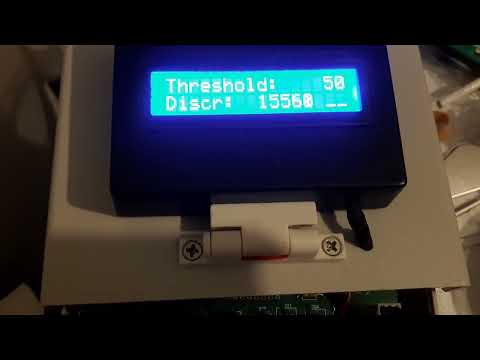
    If I set the threshold at 80 the noise triggers the audio every 2 or 3 seconds (short beep), which is livable and the detector becomes usable.
    In input terms it would be a threshold of 80 * (1.1V / 65535) / 17 = 79uV.

    So I'm adding 6 bits and code 80 is 6.3 bits... hm... perhaps this noise is the effect of not excluding the 2 LSB thrashed by the 500kHz ADC clock ???

    Regarding the schematic, it is here: https://www.geotech1.com/forums/show...213#post295213

    Leave a comment:


  • Carl-NC
    replied
    If I understand, you have an 8b ADC you are oversampling by 64x. If so, that produces an ideal 11b, not 16b. You get 1/2 bit every time you double the oversampling. So 1.1V/2^11 = 0.54mV LSB.

    Regardless, 4mV sounds a bit high. You would need to post a schematic of the front-end in order to see if this is justified.

    Leave a comment:


  • Teleno
    started a topic Noise question.

    Noise question.

    My PI design has a preamplifier gain of 17 an an ADC resolution (after oversampling/decimation at 64 samples) of 16 bits with a 1.1V reference (Atmega328P).

    I'm getting low frequency noise spikes (0.5 - 1 Hz) of 250 ADC value. This translates to about 4mV output noise and 235uV input noise.

    Is this average or below the standards of the popular PI projects?

    The ADC runs on a 500 kHz clock, so the effective resolution is 8 bits.
Working...
X