Announcement

Collapse
No announcement yet.

Announcement

Collapse
No announcement yet.

Impulse AQ - what is going on?

Collapse
X
 
  • Filter
  • Time
  • Show
Clear All
new posts

  • Impulse AQ - what is going on?

    Calabash (Digger)has been doing a bunch of YouTube videos that make the Impulse AQ and recently TDI look pretty bad. I don’t understand why his is doing so poorly. I feel mine doesn’t live up to the performance I’ve seen of others but I do ok with it.
    1) Does someone have the self resonant frequency of the large coil along with method used to measure it?
    2) Have you noticed any areas of localized heat in the control pod? Read of some but mine is fine.
    3) Have you noticed any performance changes from 1st power on to say 5 minutes later?
    4) Any differences in behavior li-ion vs metal hydride battery?

    Carl, not sure if you are involved with the AQ anymore but can First Texas work with him to get this understood?
    Someone that seemed to be from First Texas posted a comment on one of his videos indicating they’d work with him but he said later they deleted the comment.
  • #2
    Calabash generally isn't the kind of guy to work with. He likes drama and that's what his videos deliver. It's very possible that the Manticore will edge out the AQ at a white sand beach, I've never tested it against the Manticore because I don't have one and white sand beaches are a long ways away from me. Other situations may be completely different but his videos don't consider other situations. Calabash is more of a hit man than an in-depth field tester; I recall his old videos where he used some pretty bad test techniques to "show" how a particular model excelled over others. Those old videos all got deleted and I quit paying attention to him.

    To answer your questions:
    1. From memory, I think up around 700kHz but not sure
    2. Usually the lower right corner of the pod gets warm, that's where the TX circuit is at
    3. Performance should not change; threshold might but only a little
    4. Should not matter

    Comment


    • #3
      Just to be clear: the Manticore never outperforms the IMPULSE AQ on wet salt sand or on gold jewelry.

      A lot depends on how the test is done, and misleading handling can easily lead to false conclusions. If the machine is not used correctly, the comparison simply does not reflect real performance.

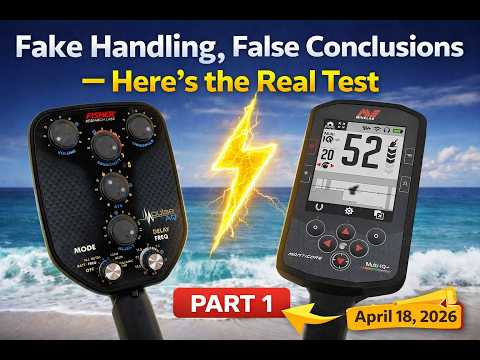
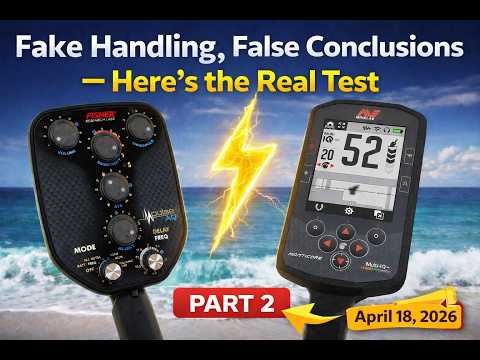
      I made two comparative videos to show proper handling and real test conditions:

      Video PART 1 : https://youtu.be/S2HotFGnX7I
      Video PART 2 : https://youtu.be/_o-t-ykowD4

      These videos show why conclusions based on incorrect handling should be taken very carefully, especially when testing on wet sand and on gold targets.
       

      Comment


      • #4
        PART 2
         

        Comment


        • #5
          Thanks for contributing!
          I think you should bring an English speaking friend along to translate. The majority of AQ videos are French language….
          I’d like to see you do an air test of the target before you put it in the wet sand because my air tests are worse than your in ground tests. Try a US nickel as an example.
          We need to set performance standards that eliminate variables like mineralization and salinity.
          What nobody shows is how to optimize the AQ for the environment. For instance you use both 7 us and 7,5us - do you see a difference between them? Is a higher ATS better than a lower sensitivity or higher delay or slower sweep?
          Which beach mode on the Manticore are you using? Much black sand at your beach?

          Comment


          • #6
            A swing like the one shown in the video is required, or perhaps even slightly slower. It is also important to remain very consistent: the coil must maintain a very stable height relative to the sand and stay as parallel to the ground as possible. This level of control then makes it possible to increase sensitivity and reduce ATS.

            This therefore requires an expert sweep technique, not the kind of sweep very often seen with detectorists using VLF or multifrequency machines, where the coil rises at the end of the swing or where the height is not kept constant throughout the motion. In these ground conditions, that kind of approximate sweep simply does not work.

            As for tests with a US nickel, meaning the American 5-cent coin, I will definitely carry them out. I do not make videos very often, but we will make more this summer, and at that time I will be sure to include that test.

            There was not much black sand on the beach where I went. The sand is mineralized, but only slightly. There is also some green clay, but it is not accessible to detectors. It lies several meters deep and, at the moment, the sand level was much too high to be able to sense it with the detector.

            I would say it is a fairly typical beach, with relatively high salinity. In other words, the kind of beach you can find almost anywhere in the world, and also in many places across the United States.

            Finally, between a pulse delay setting of 7 microseconds and one of 7.5 microseconds, there is indeed a difference in sensitivity. A shorter delay allows weaker conductivities to be picked up more easily and also provides higher sensitivity across conductivities in general. However, the detector still has to remain usable in real conditions, because this also results in a somewhat stronger response from seawater.
            Attached Files

            Comment


            • #7
              I have been trying to find scenarios where delay setting makes an obvious difference. I normally just detect in 7uS and have used other parameters to try and tame things down. This weekend I tried a setup using thin foil from a candy bar in different diameters and could see the smallest target (3/8”-1/2”) go silent with 8us or higher.

              Comment


              • #8
                You may find this Manticore vs AQ interesting:


                This is at upper Newport Beach.
                 

                Comment


                • #9
                  Originally posted by bklein View Post
                  Thanks for contributing!
                  I think you should bring an English speaking friend along to translate. The majority of AQ videos are French language….
                  ?
                  I go online only with a laptop – I don’t use a smartphone. In the lower right corner, a sign that looks like a gear wheel appears – settings. You tap (click) with your index finger on the settings – you see the caption subtitles (1) off. Under the caption off, you see English – automatically generated (or, for example, French – automatically ...). You click on the caption and when you see “automatic translation” – click! On the right, the languages ​​appear alphabetically. You scroll and find your native language. The translation is “wooden”, but satisfactory ... There are probably millions of videos on YouTube that are made by cheerful amateurs suffering from the Dunning-Kruger effect - https://i2.offnews.bg//nauka/events/..._2_559x345.jpg
                  https://en.wikipedia.org/wiki/Dunning%E2%80%93Kruger_effect

                  Their level is desperately low, and their self-esteem is that of experts. Their level is that of first graders, but they behave like teachers - they test "God forbid that the blind should see" - proverb . a small part of these "testers" have a lot of subscribers and views. If they are noticed by a large company - a manufacturer of detectors and - who pays - he orders the music (songs) this video is a nice exception ... - https://www.youtube.com/watch?v=k22FKkZjY2k

                  Comment


                  • #10
                    It has now been a little over eight years since I started working at First Texas Products, for the Fisher, Teknetics, and Bounty Hunter brands, in the field of metal detection. I work as a physicist engineer, remotely from Europe.

                    Of course, I speak English with my colleagues, but languages have always been very difficult for me. I am not particularly comfortable with that side of things, and despite that, I still wanted to make these few videos within a very limited amount of time.

                    It is also worth pointing out that the detectorists who came with their Manticore and Deus 2 were mainly there to detect for two days, not specifically to carry out in-depth testing or spend a long time filming. In the end, I was only able to devote about one hour to an hour and a half, no more than that, to talking and recording a few sequences.

                    Unfortunately, the conditions were far from ideal. It was raining, the weather was poor, and on top of that I did this outside of my working hours, over the weekend, entirely on my own initiative. My goal was simply to show, in a practical way, how PI systems work as a whole.

                    When I made that video, there was absolutely no commercial objective on my part. The detector in question is already several years old, so the interest was no longer commercial, but primarily technological. What I wanted to show is that PI technology still remains, in certain situations, clearly superior in sensitivity to the multifrequency world.

                    Multifrequency technology has improved tremendously in recent years, and its performance has clearly increased. But despite that progress, there is still a significant gap between PI technology and multifrequency technology, especially with high-end PI models, particularly those intended for beach use in all-metal mode, many of which inherited technologies originally developed by Eric Foster.

                    Of course, this level of performance is not necessarily for everyone. It mainly benefits detectorists who are willing to go beyond ordinary use: those who take the time to sweep more slowly, gain a better understanding of beaches, target more specific areas, and fully exploit the capabilities of their machine. In the end, those are the people who remain the true masters of performance.

                    Comment


                    • #11
                      Originally posted by bklein View Post
                      You may find this Manticore vs AQ interesting:


                      This is at upper Newport Beach.
                      Very interesting video, because it shows a real field limitation that many people do not fully understand until they experience it themselves.

                      Here, on some beaches along the Atlantic coast, especially in areas near Bordeaux and in the Landes region, we encounter black sands that are extremely rich in iron-bearing compounds. From our experience, once that concentration becomes high enough, no VLF or multifrequency detector sees anything anymore. I do not mean a small loss of depth or slightly unstable target IDs. I mean complete loss of useful detection, because the ground response itself becomes overwhelming compared to the target response.

                      To give a very concrete example, a 20-gram 18k gold signet ring placed directly on top of this kind of sand may not be detected at all. So we are no longer talking about reduced performance. We are talking about conditions where even a large gold target on the surface can effectively disappear for this type of technology.

                      It becomes even worse when that sand is saturated with seawater. In that case, you are combining two very difficult factors at the same time: a very strong ferruginous mineral component, and very high salt conductivity. Even when the tide has gone out and the sand is only damp, or nearly dry, VLF and multifrequency detectors are already in serious trouble on this kind of ground. When the sand is fully soaked with seawater, the problem becomes even more severe.

                      In those conditions, only PI detectors with a true ground balance remain genuinely usable. This is not really about brand loyalty or personal preference. It is mainly a matter of signal physics and of whether the detector is capable of handling a ground response that becomes much larger than the response from the target itself.

                      What is also interesting is that this phenomenon is not necessarily volcanic in origin, even though visually it can look very similar to the iron-rich black sands found on volcanic beaches. In the Landes coastal area, the geological explanation is different. The document I looked at describes clayey-peaty layers and paleosols exposed by marine erosion at the base of the dunes. Water emerging from those levels can be rich in dissolved ferrous iron, and once it reaches the surface it oxidizes, producing rusty flows, iridescent films, and visible ferruginous deposits.

                      The mechanism behind it is especially interesting. At depth, organic matter in the peaty layers can promote the reduction of ferric iron into ferrous iron, and this process can be strongly enhanced by bacteria using anaerobic respiration. Then, when that iron-rich water reaches the surface, the ferrous iron oxidizes into insoluble ferric compounds. According to the document, this oxidation is not only abiotic: it is greatly accelerated by iron-oxidizing chemolithotrophic bacteria. In other words, part of what you see on those beaches is linked to a natural sedimentary and microbiological process, not to volcanism.

                      That is also why these areas are often misunderstood. People see dark deposits, rusty outflows, rainbow-like surface films, and naturally assume pollution or some volcanic origin. But in this case, the document describes a natural coastal process associated with ancient peaty soils exposed between dune and beach, especially in areas such as Grayan-et-l’Hôpital, Vensac, and Vendays-Montalivet.

                      So, going back to the ring test, what we see in that video is entirely consistent with what we observe here. Once the ferruginous mineralization reaches a certain level, a VLF or multifrequency detector can simply stop detecting the target altogether, even if the target is lying right on the surface. And when seawater is added to the equation, the situation gets even worse.

                      In those conditions, PI is not a luxury. It is simply the appropriate technology.

                      One important nuance, though: if we want to stay scientifically rigorous, it is probably safer to describe these sands as very iron-rich or ferruginous rather than automatically calling them pure Fe3O4 magnetite. The document clearly discusses ferrous/ferric iron, ferric hydroxides, peat layers, paleosols, and bacterial iron oxidation, but it does not prove that the entire black sand component is strictly magnetite.

                      Comment

                      Working...
                      X