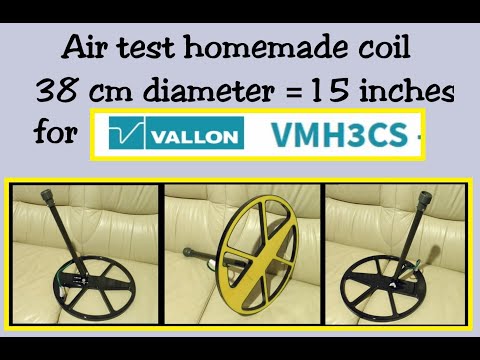
Vallon VMH3CS air test with 38 cm coil = 15 inches.
The test is conducted indoors. Settings * Normal mode *, and three measurements at different sensitivities 7.10 and 12.
At a sensitivity of 12, it starts to catch interference from the 220 volt network and the computer.
I perfectly understand that an air test is not like in the earth.
---------------------------------------
Announcement
Collapse
No announcement yet.
Vallon VMH3CS Mine Detector
Collapse
X
-
Hi. I was a little mistaken not B3 and B4, but D3 - D4.Originally posted by 6666 View PostHi, thanks for detailed reply, I am interested in your PVA glue B3 or B4, you must have different PVA glue to what we have in Australia, our PVA glue is water based, and mainly used for wood or crafts, sorry to be a pest but would you have an link to that glue so I can check it out please, as googleing it does not give good results thanks
With these adhesives you can glue almost everything.
In D4, according to the specification, after complete drying, it is completely water resistant and even holds 4 hours in boiling water.
These glues cannot be diluted with water; they lose their properties.
And what is very good when drying gives a very strong shrinkage, this contributes to good contact between the particles of graphite.
We stock a wide range of adhesives and glues for wood, metal, insulation materials and rubber based products. Order before 3pm for next-day delivery.
PVA glue, which is not recommended to be diluted with water:
Universal glue (PVA-D3, D4).
Super PVA glue (PVA-D3, D4).
These types of adhesives have a white or slightly yellowish tint and when thickened they can be diluted with acetic acid or organic solvents (acetone, methanol, ethyl acetate, benzene ...).
These plasticized adhesives are amenable to partial dissolution with water, but at the same time their properties (frost and water resistance) are reduced.
Leave a comment:
-
Originally posted by Myntmaster View PostHi.
I make a graphite coating based on PVA glue B3 or B4.
After drying, the layer is completely water repellent. There are no special proportions. I take 100 ml. glue in a separate jar with a lid.
I sprinkle three teaspoons of graphite. Add one spoon, stir every time. Mixing thoroughly, I make control smears on paper.
It is necessary to measure after complete drying. If the resistance is in the range of 400-600 Ohms per 1 cm, then this is normal.
If the resistance is large, I add more graphite. If the mixture is thick or then slightly thickened, it can be diluted with acetone or solvent 646.
Store the finished mixture in a tightly closed jar. Stir well before each use.
Hi, thanks for detailed reply, I am interested in your PVA glue B3 or B4, you must have different PVA glue to what we have in Australia, our PVA glue is water based, and mainly used for wood or crafts, sorry to be a pest but would you have an link to that glue so I can check it out please, as googleing it does not give good results thanks
Leave a comment:
-
Hi.Originally posted by 6666 View PostThank you, what are you mixing it with and what ratio, what resistance do you get ? thanks
I make a graphite coating based on PVA glue B3 or B4.
After drying, the layer is completely water repellent. There are no special proportions. I take 100 ml. glue in a separate jar with a lid.
I sprinkle three teaspoons of graphite. Add one spoon, stir every time. Mixing thoroughly, I make control smears on paper.
It is necessary to measure after complete drying. If the resistance is in the range of 400-600 Ohms per 1 cm, then this is normal.
If the resistance is large, I add more graphite. If the mixture is thick or then slightly thickened, it can be diluted with acetone or solvent 646.
Store the finished mixture in a tightly closed jar. Stir well before each use.
Leave a comment:
-
Originally posted by Myntmaster View PostI take from England.https://www.inoxia.co.uk/products/ch...raphite-powder
---------
[ATTACH]49231[/ATTACH]
[ATTACH]49232[/ATTACH]
[ATTACH]49233[/ATTACH]
Thank you, what are you mixing it with and what ratio, what resistance do you get ? thanks
Leave a comment:
-
Leave a comment:
-
-
-
-
O.K. I did wonder if it was a typo, but had to laugh at the thought of oven-engineering. The sort of mistake a Chinese translator would make. I once saw an advert for a stereo phono cartridge where 'channel separation' was translated as 'chemical isolation'.Originally posted by brinbrin View PostSorry, it only was a typo. No way to "oven-engineer" anything, or maybe glass, ceramics, metal alloys, resins, etc, but certainly not a metal detector.
Eric.
Leave a comment:
-
Sorry, it only was a typo. No way to "oven-engineer" anything, or maybe glass, ceramics, metal alloys, resins, etc, but certainly not a metal detector.
Leave a comment:
-
No, it wasn't heated in an oven. 'Over-engineered' means that the construction is stronger, sealings better, and fixings more secure, so as to ensure reliability in war zone conditions and manhanding by soldiers. The engineering level that would be classed as good for hobby use would not have survived very long in Afghanistan or Iraq.Originally posted by brinbrin View PostWow, you used the word "oven-engineered" and I understand why. So, no chance there is a faulty soldering there. I guess the pins must have worn out, and beside replacing the upper shaft and the lower shaft/coil, there is no practical solution. Well, I'll make do with what I have. Eventually, I'll mod the whole unit to make it lighter. Thanks a lot for your answers.
Eric.
Leave a comment:
-
Wow, you used the word "oven-engineered" and I understand why. So, no chance there is a faulty soldering there. I guess the pins must have worn out, and beside replacing the upper shaft and the lower shaft/coil, there is no practical solution. Well, I'll make do with what I have. Eventually, I'll mod the whole unit to make it lighter. Thanks a lot for your answers.
Leave a comment:
Leave a comment: