
point T4
-
I read all 147 pages but only thing i saw was your anger with other members not right advice
Also i saw 2 or 3 pictures from scope diagram on these 147 pages that were related to test points tr2, tr3 , tr4 , tr5Leave a comment:
-
this thread 147 pages and 3600 posts. again to begin from start?
i see diagram in 45 post, for example.
all my videos with all signals were in youtube. but it deleted my channel with resume i'm 'the spammer'.Leave a comment:
-
on pin 6 - this is OUTPUT of operational amplifier (opamp, op amp, op-amp) - is impulse signal,
it is 'cutted 'delta' pulse on its top' but inverted (cutted by two diodes VD3 and VD4). the opamp is in invertor circuit usage here.
so you see via your oscilloscope the 'low part' of whole 'delta' pulse on coil.
no DC signal you would be like to measure by a tester. without mos-fet on output of the opamp is GND (ground, zero) level, in relation to output of DA4:A.Leave a comment:
-
Chub, that is a very sharp and clear image you have shown, I've never seen better. The scope trace is very nicely focused and the camera is high resolution, congratulations.
I can barely make out what's going on.Leave a comment:
-
0.25 mm for a 280 mm coil. For 280 mm coil, you should use 0.50 or 0. 60 mm wire.
Hi TufaN!
Thanks for your tests, perfomance are realy realy not bad! I see distance 40+ cm to coin.
What about current consumtion, how much mA your DP takes from battery?Leave a comment:
-
I will make a new 28cm coil as you said.
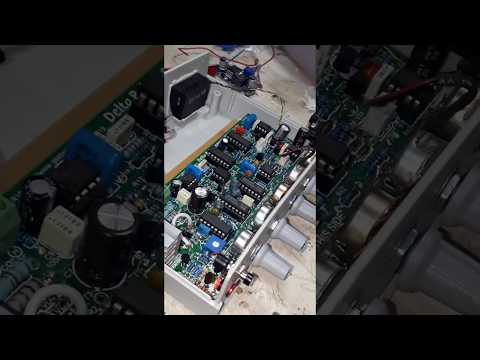
Looks like your board has lost some tracks. Mine too. I am going to order new boards from China but got no clue on specifications for durable tracks.Leave a comment:
-
dbanner I will do the with test as advised by you on next weekend.
Today i wound a 280mm diameter coil with 0.25mm wire. Inductance is 486 uH but resistance is 9.6R (including the connecting cable and connector) which i am sure is very very high. How i can adjust such high resistance coil with the DP ? (i will change other components for small coil as written in BOM).
Thank youLeave a comment:
-
Chuubaba, did you put scope probe to leg 6 of the LF356? What did you see?
Stop buying chips online, most are fake except from reputable supplier. You must learn to salvage these common chips from old equipment tossed out such as old Graphic equalizers, mixers, preamps and old car amplifiers and other type of audio equipment contain a bunch of these very common op-amps. Dig around the town!Leave a comment:
Leave a comment: