Announcement

Collapse
No announcement yet.

Announcement

Collapse
No announcement yet.

Pulse Damping Resistor

Collapse
X
 
  • Filter
  • Time
  • Show
Clear All
new posts

  • Pulse Damping Resistor

    In pulse induction (PI) detectors, a damping resistor is traditionally used in the TX stage to suppress the flyback voltage that occurs when the coil current is switched off. However, with this method, the energy stored in the coil is dissipated directly as heat, and control over the pulse waveform remains limited.

    At this point, has anyone tried implementing an active clamp topology using a MOSFET and a capacitor instead of a damping resistor? In particular, it seems theoretically possible to redirect the coil energy to a clamp capacitor at the moment the current is interrupted, thereby limiting Vds stress and achieving more controlled damping. In theory, this approach could offer lower losses, improved pulse repeatability, and potential EMI advantages.

    However, since the measurement window in PI systems is extremely critical, important design considerations would include whether the switching noise of the active clamp affects the RX stage, the avalanche robustness of the MOSFET, optimization of the clamp capacitor value, and precise gate timing control.

    Has anyone implemented this method in practice or evaluated it through simulation and measurement? Compared to the conventional damping resistor approach, does it provide a meaningful real-world advantage, or is it generally avoided due to increased complexity and noise risk? I would appreciate hearing your experiences and recommendations.

  • #2
    Yes, this is done in energy-recycling kickstart circuits. The Garrett ATX/Axiom does it like this:

    Click image for larger version  Name:	image.png Views:	0 Size:	29.4 KB ID:	445590
    which is almost identical to patent US9366778. During turn-off, D2 and the cap act like a snubber circuit and dump the coil energy on the cap. At the next turn-on, that energy provides a high-voltage "kick start" which ramps up the coil current much faster. Here is the Garrett waveform:

    Click image for larger version  Name:	image.png Views:	0 Size:	22.3 KB ID:	445591
    The kick start drives the short pulse but not the long pulse.

    Minelab uses a different form of the same technique in the GPZ7000. It's been discussed in this thread:

    https://www.geotech1.com/forums/foru...ve-to-h-bridge

    Comment


    • #3


      Comment


      • #4


        Click image for larger version

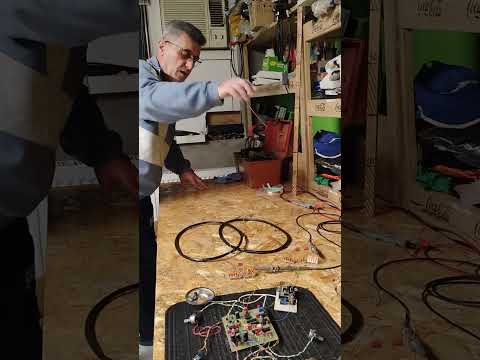
Name:	viber_изображение_2026-02-12_17-20-50-445.jpg
Views:	194
Size:	71.1 KB
ID:	445607

        Comment


        • #5
          Originally posted by pechkata View Post


          Click image for larger version  Name:	viber_изображение_2026-02-12_17-20-50-445.jpg Views:	0 Size:	71.1 KB ID:	445607
          Pechkata :
          You went the wrong way. Current is not measured that way..!

          Comment


          • #6
            Everything shown in the video is measured in the right way. Orbita makes the same video, let's see how you measure? Anyone can write in words, but the important thing is what a person does, and the colleague, the stove, does not stop and one day will improve. , I admire him.

            Comment


            • #7
              Originally posted by Orbit View Post
              Pechkata :
              You went the wrong way. Current is not measured that way..!


              https://www.geotech1.com/forums/foru...ka-smart-pulse

              Comment


              • #8
                Originally posted by algan View Post
                Everything shown in the video is measured in the right way. Orbita makes the same video, let's see how you measure? Anyone can write in words, but the important thing is what a person does, and the colleague, the stove, does not stop and one day will improve. , I admire him.
                Yes, I was making a mistake too! But that's not how it's measured. Of course, I have nothing against anyone, let them measure as they want. And I also support anyone who is persistent in anything.

                Comment


                • #9
                  Originally posted by Orbit View Post

                  Yes, I was making a mistake too! But that's not how it's measured. Of course, I have nothing against anyone, let them measure as they want. And I also support anyone who is persistent in anything.
                  I don't understand what kind of current this is.
                  Where did you see a current measurement?

                  Comment


                  • #10
                    Karl's diagram shows the shape of the current! Let Carl explain. What you measure is another.

                    Comment


                    • #11
                      Check out this topic.

                      https://www.geotech1.com/forums/foru...ve-to-h-bridge

                      You will understand this:

                      "At this point, has anyone tried implementing an active clamp topology using a MOSFET and a capacitor instead of a damping resistor? In particular, it seems theoretically possible to redirect the coil energy to a clamp capacitor at the moment the current is interrupted, thereby limiting Vds stress and achieving more controlled damping. In theory, this approach could offer lower losses, improved pulse repeatability, and potential EMI advantages."


                      Comment


                      • #12
                        Originally posted by pechkata View Post
                        Check out this topic.

                        https://www.geotech1.com/forums/foru...ve-to-h-bridge

                        You will understand this:

                        "At this point, has anyone tried implementing an active clamp topology using a MOSFET and a capacitor instead of a damping resistor? In particular, it seems theoretically possible to redirect the coil energy to a clamp capacitor at the moment the current is interrupted, thereby limiting Vds stress and achieving more controlled damping. In theory, this approach could offer lower losses, improved pulse repeatability, and potential EMI advantages."


                        If I deviated from the topic, I'm sorry. Of course it is possible!

                        Comment


                        • #13


                          "Technically it is a form of PI but requires an IB coil. It transfers the magnetic field energy onto the coil capacitance as an electric field energy, then immediately reverses the process to the opposite direction. No damping resistor is needed because there is no free-running oscillation to dampen. That is, the coil is always driven and never left open.

                          The diode is just a protection device to prevent unwanted spikes (during the transitions) from zapping the preamp. If you could make a perfect IB coil then they would not be needed.​"

                          Comment

                          Working...
                          X