 Tweet
Tweet
-
-
Before the final WS43 project, I did several "lighter" and simpler projects.
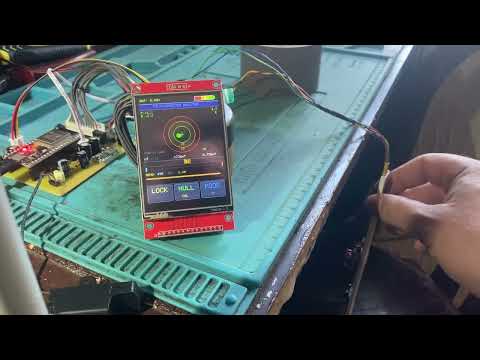
One is particularly interesting because it only uses 1 sensor and a gyroscope and serves as a pinpointer (up to several meters depth though).
Comment
-
Comment
-
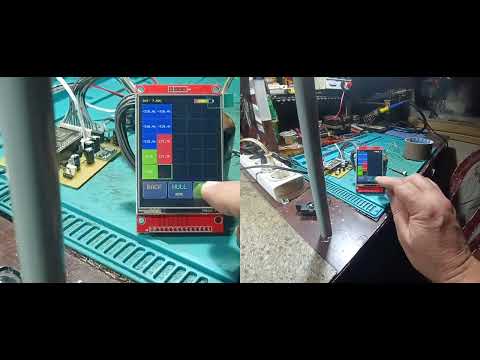
This is a good example to compare the power of ESP32-P4 and ESP32-S3.
On this project with 1 sensor and a gyroscope, the main processor is ESP32-S3.
Considerably weaker than ESP32-P4.
The grid is a fixed size of 5x5 and isometric 3D rendering is obviously slower and of lower quality.
But it is good enough for mapping smaller areas.
It has no file system and no connection with Android, it is designed as an "instant" instrument for quick checks of soil conditions (or some other, perhaps industrial application).
Comment
-
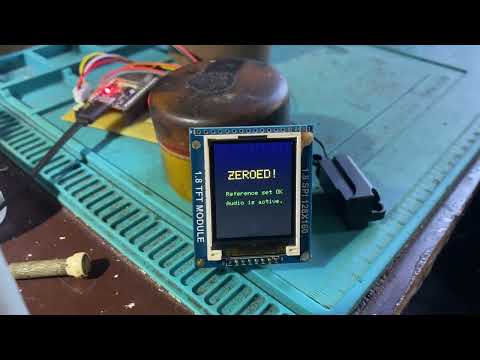
The simplest project is with a 1.8" (non-touch) display.
"Null" is a physical button and "Sens" is a physical potentiometer.
It is designed as a small manual pointer for very fast tests.
Comment
-
One of the "transitional" projects is the WS2, which has a 2" TFT Touch screen and an ESP32-S3 processor.
It was the work from which I added an external ADC.
It was the "key work", which showed me the direction in which I had to move further in development.
Comment
-
So even though my posts are chronologically disorganized; the true chronological list of development to arrive at the final WS43 project is as follows:
1) 1.8", ESP32-S, no "Touch", no external ADC, 1 sensor.
2) 2.8", ESP32-S, "Touch", no external ADC, 1 sensor + gyroscope, 5x5 grid mapping with rudimentary 3D isometry.
3) 2", ESP32-S3, "Touch", external ADC, 1 or 2 sensors, BT streaming, some other features.
4) 4.3", ES32-P4, "Touch", external ADC, 1 or 2 sensors, BT streaming, full scale 2D/3D mapping, file system, micro SD card, etc...
I drew a couple of important conclusions from these works:
- Without an external ADC and a good DSP, the projects are "lighter category", very usable for simple instant tests and checks on soils.
But they provide low-end performance. Usable in various applications that do not require high precision and resolution.
- ESP32-S and ESP32-S3 are of respectable performance but for real multitasking that includes serious DSP and 2D/3D mapping; are not enough.
- ESP32-P4 is a "beast" and can easily multitask, no sweat, very complicated DSP algorithms + do serious 2D/3D rendering at the same time, easily supports file system and BLE communication with little and in most of the cases no effort at all.
I have noticed an increased interest in various "stick" magnetometers and the appearance of several products from small independent manufacturers is noticeable.
I had the opportunity to hold most of them in my hands and test them thoroughly.
Despite the often high prices, none of these products can be classified as better than "low end" category, I'm sorry, but that's a fact.
Serious performance requires much more than mere enthusiasm and putting high prices on beautifully decorated toys.
...
Therefore, from all similar devices that I have tested so far as well as from my personal projects; only and exclusively 4.3", the ES32-P4 project can be classified in the "mid-range" category, with some specifications that even exceed that category.Comment
-
And now a few words about the sensors.
I took the famous FLC-100 sensor as the main reference for working on projects.
However, I was fortunate to have a collaborator in China, a very smart and educated young man, who dedicated himself to developing quality sensors.
And after 3 years of hard development work, many expenses along the way, he made a remarkable success by achieving top performance with his "HDC100" sensor and typically the same performance as original FLC-100 with his "FLCH-101" sensor.
He provided me with several copies of those sensors and that's how I got into a situation where I could change the sensors and compare the performances.
Real progress and peak performance can only be seen when using an external ADC and HDC100 sensor.
The differences are ... to put it mildly: HUGE!
The colleague from China did not stop there, in the meantime he is developing an even better sensor.
He had to temporarily stop his work due to some unforeseen personal problems.
But I sincerely hope that he will overcome these problems and continue his development soon.
But until that happens, the HDC100 remains one of the best sensors I've worked with to date.Comment
-
I did add a few extras, but not that many.Originally posted by Carl-NC View Post
I don't seem to have them either, but will try and find some replacements.
Comment
Comment